Here is a view from the relatively modern kitchen back into the 300+ year old portion of the house. That wall would have been an exterior wall when it was constructed and it surely is about four feet thick.
Our plan for the day was the Blenheim Palace, a World Heritage site. The Palace is the home of the 12th Duke of Marlborough, sitting on the 12,000 acre estate of the Duke. The plan was to walk over there and get a bus back.
So along the way we again passed through parts of the village. Notably we passed near the old church and this time we went inside. Officially it is Saint Laurence's Church
A church at Combe existed by about 1141. Parts of the current building are 12th century, including the inner doorway of the north porch. The nave was rebuilt near the end of the 14th century, about 1395, and is notable for its 14th- or 15th-century stone and a set of wall paintings dating from about 1440. The church has remnants of a set of 15th-century stained glass windows. The most complete survivor is one on the southeast corner of the nave depicting Saint James the Great.
Our guide noted that this part of England was a significant early hotbed of what eventually boiled out as Methodism. The story says that John Wesley preached from the pulpit of this church at least several times.
We wandered across the village playing fields. The fields were donated to the village in 1948 by the Duke of Marlborough. There was a ceremony and the Duke of Edinburgh attended and planted the tree here in the foreground. In 1948 the Duke was not yet Prince, his wife Elizabeth did not become Queen until 1953.
That's the cricket ground in the background with the football pitch just a bit further along, The old church is visible pretty much frame center beneath the branches of the tree and beyond the playing fields.
On to the Palace. The Duke has had 12,000 acres since about 1705. The grounds are quite a bit less than a formal garden, 12,000 is huge number of acres, about 19 square miles, too much for a formal garden. But it all seems pretty obviously planned, complete with an artificial lake and lots of spots where things were planted.
Have a plan for planting and then wait 300 years and you get a really gorgeous landscape. Here is a look up one of the valleys.
Eventually we came out to the Disney lake and got this view of the bridge over the lake to the main entrance of the palace.
A bit later and up to the main entrance of the house.
John Churchill was a capable military commander who won several significant military engagements during the War of Spanish Succession. Following a victory over the French at Blenheim, Austria, in 1702, the grateful Queen Anne decided to reward him. He was elevated from Earl to Duke and granted tenancy of the royal manor that is now the home of the current Duke.
Along the way the Palace just happens to have been the birthplace of Winston Churchill.
This is a statue of Queen Anne located in the library of the Palace.
This is a flattering rendition, she was said to be as wide as she was tall as a result of enduring 17 pregnancies in an attempt to produce a royal heir, a result that ultimately she was not able to achieve.
Queen Anne provided much of the funding necessary for construction of the Palace but as years went along the estate was subject, as are all things, to the vagaries of the world financial scene. By the late 19th century the 9th Duke had fallen into debt. It was the Gilded Age in America and Alva Vanderbilt, wife of a Vanderbilt railroad millionaire, was seeking a socially advantageous match for her only daughter and eldest child. Consuela Vanderbilt thus became the 9th Duchess of Marlborough and the Vanderbilt fortune saved the Duke from financial ruin. It seems likely to me that at some point Anderson Cooper will be doing a CNN special.
This is the family chapel, but no, the wedding occurred at Saint Thomas Episcopal Church in New York City.
We left the Palace and walked across the lawn to the town of Woodstock.
Woodstock had been there even before the Palace was built. Here is one of the oldest coaching inns in England, dating from the 13th century.
Famous guests over the years include Richard Burton and Elizabeth Taylor.
Wednesday, June 21, 2017
Tuesday, June 20, 2017
Travel to Oxfordshire
We caught the 14:06 train from London Marylebone Station for a 15:02 arrival at Oxford Parkway Station, about 50 miles west of London.
Here is the FT as we had some lunch at Marylebone.
We are spending a couple of days with Sid and Elena. They live in the small village of Combe, near Woodstock, and about 10 miles northwest of Oxford. This is their house.
The house was struck by lightning about four weeks ago and suffered some major damage. However, a 400 year old stone house has been around long enough to prove that it is going to take quite a lot to destroy. A direct lightning strike did not.
The tall bit on the right is about 400 years old. The shorter bit in the center with the second chimney is about 300 years old, the part on the right with the slanted roof is only a couple of hundred years. The part on the far left with a garage is about 15 years old.
The stone walls are so thick that I get no cell phone signal inside the house.
All of that stone was piled up long after the town church.
Elena says the church dates from the 13th century, which makes it more than 700 years old.
We had a wonderful grilled tuna a aubergine dinner in their garden.
Here is the FT as we had some lunch at Marylebone.
We are spending a couple of days with Sid and Elena. They live in the small village of Combe, near Woodstock, and about 10 miles northwest of Oxford. This is their house.
The house was struck by lightning about four weeks ago and suffered some major damage. However, a 400 year old stone house has been around long enough to prove that it is going to take quite a lot to destroy. A direct lightning strike did not.
The tall bit on the right is about 400 years old. The shorter bit in the center with the second chimney is about 300 years old, the part on the right with the slanted roof is only a couple of hundred years. The part on the far left with a garage is about 15 years old.
The stone walls are so thick that I get no cell phone signal inside the house.
All of that stone was piled up long after the town church.
Elena says the church dates from the 13th century, which makes it more than 700 years old.
We had a wonderful grilled tuna a aubergine dinner in their garden.
Monday, June 19, 2017
When it is this hot one should endeavor to remain indoors
And mostly we did just that
Except that we took a morning walk, only a few short blocks, up to what was at one time a fiercely trendy shopping area on King's Road. I read the guide books, noted average temperatures, and packed for average June in London. Instead we have arrived to the warmest June in London since 1976, a year famous for a severe heat crisis that spread all across Europe.
I was looking for a pair of shorts. Mission accomplished.
And then there was this, of course.
That's the FT emerging from Trotters, a small shop specializing in children's wear. Eventually more will be revealed about what it was she was doing in there.
We also had lunch at a sandwich shop on King's Road before rejoining the group for a swelteringly warm cab ride to the British Museum.
It is a great, free museum. It was established in 1753, largely based on the collections of the physician and scientist Sir Hans Sloane. For me the museum contains some unbelievable could not miss seeing touchstones of Western Civilization.
Like the Rosetta Stone.
The ultimate decoder ring.
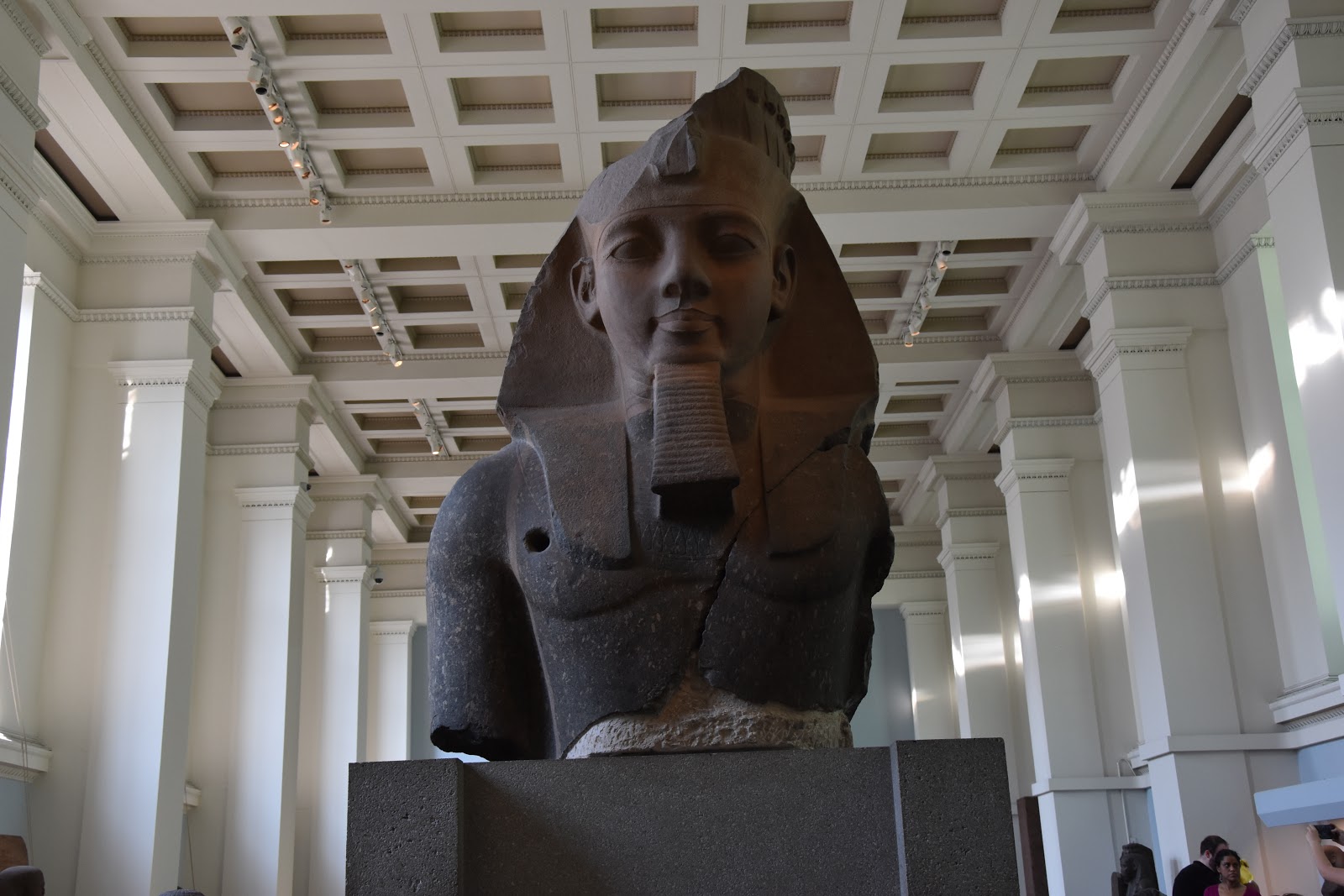
This is King Rameses II.
This seven ton statue is made of two different colors of granite. It is a fragment from a temple in Thebes.
This is an amphora, or wine jar. This one is from about 540 BC and is painted with a legend from the Trojan War (about 1200 BC). The painting is of Achilles facing off with Penthesilea, the Queen of the Amazons. Achilles slays her with a spear but as he does so she looks up and their eyes lock. He is instantly smitten but she dies.
The other main could not miss for me was the stolen Parthenon Galleries In the early 1800s the British ambassador to Greece ordered that the sculpture panels be hammer, chisel and sawed off from the Parthenon itself (which, of course, still stands). In recent years the Greeks have become increasingly resentful of this Greek treasure being located in England.
These are the Pediment Sculptures.
These were above the columns over the east (main) entrance of the Parthenon. The central figures of this display depict the birth of Athena. Zeus had his head split open, allowing Athena, the goddess of wisdom, to rise from his brain fully grown and fully armed, inaugurating the Golden Age of Athens.
This is the Holy Thorn Reliquary.
This was created for a member of the French royal family about 1400. It is designed to house a relic of the Crown of Thorns, in this case, a single thorn.
90 here today. 90 again tomorrow. The FT and I will be leaving the city to try to beat the heat. We have tickets for the 14:02 train from London Marylebone for a 15:06 arrival at Oxford Parkway Station in Oxfordshire.
Except that we took a morning walk, only a few short blocks, up to what was at one time a fiercely trendy shopping area on King's Road. I read the guide books, noted average temperatures, and packed for average June in London. Instead we have arrived to the warmest June in London since 1976, a year famous for a severe heat crisis that spread all across Europe.
I was looking for a pair of shorts. Mission accomplished.
And then there was this, of course.
That's the FT emerging from Trotters, a small shop specializing in children's wear. Eventually more will be revealed about what it was she was doing in there.
We also had lunch at a sandwich shop on King's Road before rejoining the group for a swelteringly warm cab ride to the British Museum.
It is a great, free museum. It was established in 1753, largely based on the collections of the physician and scientist Sir Hans Sloane. For me the museum contains some unbelievable could not miss seeing touchstones of Western Civilization.
Like the Rosetta Stone.
The ultimate decoder ring.
This is King Rameses II.
This seven ton statue is made of two different colors of granite. It is a fragment from a temple in Thebes.
This is an amphora, or wine jar. This one is from about 540 BC and is painted with a legend from the Trojan War (about 1200 BC). The painting is of Achilles facing off with Penthesilea, the Queen of the Amazons. Achilles slays her with a spear but as he does so she looks up and their eyes lock. He is instantly smitten but she dies.
The other main could not miss for me was the stolen Parthenon Galleries In the early 1800s the British ambassador to Greece ordered that the sculpture panels be hammer, chisel and sawed off from the Parthenon itself (which, of course, still stands). In recent years the Greeks have become increasingly resentful of this Greek treasure being located in England.
These are the Pediment Sculptures.
These were above the columns over the east (main) entrance of the Parthenon. The central figures of this display depict the birth of Athena. Zeus had his head split open, allowing Athena, the goddess of wisdom, to rise from his brain fully grown and fully armed, inaugurating the Golden Age of Athens.
This is the Holy Thorn Reliquary.
This was created for a member of the French royal family about 1400. It is designed to house a relic of the Crown of Thorns, in this case, a single thorn.
90 here today. 90 again tomorrow. The FT and I will be leaving the city to try to beat the heat. We have tickets for the 14:02 train from London Marylebone for a 15:06 arrival at Oxford Parkway Station in Oxfordshire.
Sunday, June 18, 2017
Hot and touristy
Well, if it is Sunday, sunny and warm, it must be time to head out to what is most likely going to be one of the most tourist rich environments on the planet, Westminster.
As most will be able to guess, outcomes were mixed.
We hiked up to the nearest tube stop (previously featured South Kensington), minted a set of Oyster cards, and boarded the District line (although there is just a tiny chance it was the Circle line, both lines are using the same tracks at this point) and cruised down an easy four stops to Westminster.
It was a lot like when Wireless first took us to Paris. On that occasion she led us out of the Concorde station, we turned left and there was la Tour Eiffel. This time we walked up the steps of Westminster and there was Big Ben and the Houses of Parliament.
The sun angle wasn't the greatest. I ended up walking around over to Parliament Square before I finally got one I liked of Big Ben.
It's OK, it was actually several years and a couple of trips before I got the photograph I like of the view of the tower from Concorde. Life is not a photo opportunity and the memory of the first glimpse of Big Ben is clear and strong.
It was Sunday so we headed over to the big stone church, in this case Westminster Abbey. We approached from the the Saint Margaret's side, the north. This is the north porch, midway up the side of the big church.
Everything I know about interpreting the art on the outside of these old buildings I learned from a couple of tours I have taken with the Englishman Malcolm Miller at the Cathedral at Chartres in France.
The main, larger opening features God the Father, the 12 apostles with a centerpiece of Mary and Jesus. That's about the best I can do but Malcolm did teach me to look and those figures and not just look at them but try to figure out the story they are telling.
Here's one I like the lighting on, a look down the north side of the church to the northwestern towers at the front of the church.
That makes that a backdoor look at the front door.
Sunday, the church wasn't open for tours but it was open for church. We attended the 11:15 service The FT and I have now attended worship services at Westminster Abbey and Notre Dame de Paris.
If you want to take pictures inside the church you probably have to pay for the tour. The English were hovering about pretty determinedly discouraging any loitering.
The memory is still clear and strong. Amazing church.
Here is the west end entrance.
What they have above the door on this side is a group of 10 martyrs of the 20th century. Five in from the left is Martin Luther King.
We followed Whitehall Street towards Trafalgar Square. We passed by some stuff that on another day I might have tried to photograph, like the Cenotaph, the Horse Guards and the thoroughly blocked off entrance to Downing Street. I did get the obligatory shot of Lord Nelson.
Nelson saved England in 1805 by attacking and defeating the French fleet off Spain, at Trafalgar. Nelson himself was killed in the battle but with the French fleet destroyed Napoleon was unable to get across the Channel to invade England.
Nelson died proclaiming, "Thank God, I have done my duty".
Here's the London Eye, a really big ferris wheel.
The golden eagle is a memorial to the air force and naval air flyers who perished defending England in the two big wars.
This is Boadicea, Queen of the Iceni, a Celtic tribe living in the London area when the Romans arrived. The Romans mostly subdued and civilized the natives but after Romans raped her two daughers, Boadicea rallied her people. They painted themselves blue and went to war, eventually liberating London and massacring its 60,000 Roman citizens.
The Romans reorganized and Boadicea and her family took poison to avoid surrendering.
I know people are interested in this sort of thing. This is where we are staying, the Nell Gwynn House Apartments.
Nell Gwynn was a long time mistress of King Charles II. eventually having two sons with him. She was known as "pretty, witty, Nell" but she was a mistress, not a queen, her two sons with the King received titles but did not become kings.
And then this: We would be lost without this place, almost directly across the street.
Actually directly across the street is Starbucks, of course.
Way too hot, way too many tourists.
As most will be able to guess, outcomes were mixed.
We hiked up to the nearest tube stop (previously featured South Kensington), minted a set of Oyster cards, and boarded the District line (although there is just a tiny chance it was the Circle line, both lines are using the same tracks at this point) and cruised down an easy four stops to Westminster.
It was a lot like when Wireless first took us to Paris. On that occasion she led us out of the Concorde station, we turned left and there was la Tour Eiffel. This time we walked up the steps of Westminster and there was Big Ben and the Houses of Parliament.
The sun angle wasn't the greatest. I ended up walking around over to Parliament Square before I finally got one I liked of Big Ben.
It's OK, it was actually several years and a couple of trips before I got the photograph I like of the view of the tower from Concorde. Life is not a photo opportunity and the memory of the first glimpse of Big Ben is clear and strong.
It was Sunday so we headed over to the big stone church, in this case Westminster Abbey. We approached from the the Saint Margaret's side, the north. This is the north porch, midway up the side of the big church.
Everything I know about interpreting the art on the outside of these old buildings I learned from a couple of tours I have taken with the Englishman Malcolm Miller at the Cathedral at Chartres in France.
The main, larger opening features God the Father, the 12 apostles with a centerpiece of Mary and Jesus. That's about the best I can do but Malcolm did teach me to look and those figures and not just look at them but try to figure out the story they are telling.
Here's one I like the lighting on, a look down the north side of the church to the northwestern towers at the front of the church.
That makes that a backdoor look at the front door.
Sunday, the church wasn't open for tours but it was open for church. We attended the 11:15 service The FT and I have now attended worship services at Westminster Abbey and Notre Dame de Paris.
If you want to take pictures inside the church you probably have to pay for the tour. The English were hovering about pretty determinedly discouraging any loitering.
The memory is still clear and strong. Amazing church.
Here is the west end entrance.
What they have above the door on this side is a group of 10 martyrs of the 20th century. Five in from the left is Martin Luther King.
We followed Whitehall Street towards Trafalgar Square. We passed by some stuff that on another day I might have tried to photograph, like the Cenotaph, the Horse Guards and the thoroughly blocked off entrance to Downing Street. I did get the obligatory shot of Lord Nelson.
Nelson saved England in 1805 by attacking and defeating the French fleet off Spain, at Trafalgar. Nelson himself was killed in the battle but with the French fleet destroyed Napoleon was unable to get across the Channel to invade England.
Nelson died proclaiming, "Thank God, I have done my duty".
Here's the London Eye, a really big ferris wheel.
The golden eagle is a memorial to the air force and naval air flyers who perished defending England in the two big wars.
This is Boadicea, Queen of the Iceni, a Celtic tribe living in the London area when the Romans arrived. The Romans mostly subdued and civilized the natives but after Romans raped her two daughers, Boadicea rallied her people. They painted themselves blue and went to war, eventually liberating London and massacring its 60,000 Roman citizens.
The Romans reorganized and Boadicea and her family took poison to avoid surrendering.
I know people are interested in this sort of thing. This is where we are staying, the Nell Gwynn House Apartments.
Nell Gwynn was a long time mistress of King Charles II. eventually having two sons with him. She was known as "pretty, witty, Nell" but she was a mistress, not a queen, her two sons with the King received titles but did not become kings.
And then this: We would be lost without this place, almost directly across the street.
Actually directly across the street is Starbucks, of course.
Way too hot, way too many tourists.
Saturday, June 17, 2017
Tough day for horses
It was a little too warm and surprisingly mostly sunny for today's second day of orientation/settling in/overcoming the jet lag. We thought that another day of walking might be the ticket. Exercise is good for overcoming the lag, it makes you tired which encourages sleep. Which is the deal that ultimately fixes the other stuff.
So off we went. It was a little too warm and a little too sunny, a tough day for horses.
We endeavored to persevere.
And with all due respect to Chief Dan George, I think we were adequate.
We walked mostly over towards the local river, eventually getting across on the Chelsea Bridge. We were then in Battersea Park, a mighty fine urban oasis. We stopped for hydration and nutrition at this establishment.
Apparently none of us made the appropriate inquiry because we don't really know but my guess is that something called "Pier Point" is nearby. There was a multi-lingual male and a Romanian female staffing the stand. We know this because person who immediately becomes best friends with whomever she meets was in our party and therefore those inquiries were made.
This is the way back, the Albert Bridge.
Also described as the Victorian Albert Bridge by one guidebook. I am guessing Albert Bridge built during the Victorian era.
The bridge features a warning sign that it is a Weak Bridge, capable of standing up to loads of only 3 tons.
We qualified safely under that limit and walked across. While we were crossing we were entertained by a flyby by the Royal Air Force including old and new, small and large, and a final set of jets leaving red, white and blue smoke plumes behind.
We believe it was the Queen's Birthday.
This is the excellent art deco Michelin Building as encountered on the trek back to our place of lodging.
This fulfills the requirement of bicycle content as most will know that my bicycle tire brand of choice is represented by this building.
So we had dinner at a nice fish/Italian place. We had to eat there because PWIBBFWWSM (see above) had done a neighborhood reconnaissance and was close personal friends with the cafe owner. It was very good.
One last walk around the neighborhood for FT and myself.
I think this may fulfill the requirement for public transportation content.
I am tired to the very bones.
So off we went. It was a little too warm and a little too sunny, a tough day for horses.
We endeavored to persevere.
And with all due respect to Chief Dan George, I think we were adequate.
We walked mostly over towards the local river, eventually getting across on the Chelsea Bridge. We were then in Battersea Park, a mighty fine urban oasis. We stopped for hydration and nutrition at this establishment.
Apparently none of us made the appropriate inquiry because we don't really know but my guess is that something called "Pier Point" is nearby. There was a multi-lingual male and a Romanian female staffing the stand. We know this because person who immediately becomes best friends with whomever she meets was in our party and therefore those inquiries were made.
This is the way back, the Albert Bridge.
Also described as the Victorian Albert Bridge by one guidebook. I am guessing Albert Bridge built during the Victorian era.
The bridge features a warning sign that it is a Weak Bridge, capable of standing up to loads of only 3 tons.
We qualified safely under that limit and walked across. While we were crossing we were entertained by a flyby by the Royal Air Force including old and new, small and large, and a final set of jets leaving red, white and blue smoke plumes behind.
We believe it was the Queen's Birthday.
This is the excellent art deco Michelin Building as encountered on the trek back to our place of lodging.
This fulfills the requirement of bicycle content as most will know that my bicycle tire brand of choice is represented by this building.
So we had dinner at a nice fish/Italian place. We had to eat there because PWIBBFWWSM (see above) had done a neighborhood reconnaissance and was close personal friends with the cafe owner. It was very good.
One last walk around the neighborhood for FT and myself.
I think this may fulfill the requirement for public transportation content.
I am tired to the very bones.
Friday, June 16, 2017
Far from home again
Boy, this travel thing is really hard.
We had some setbacks. The wait at Passport Control was excruciatingly difficult.
But just as Mr. Steeves predicted we got a chatty, friendly, really helpful cab driver and he whisked us away to our temporary lodgings in Chelsea. Some of us, me for example, were not feeling our best. We took a short lay down and rallied for an attempted walk around the neighborhood.
We were just staggering along, hoping to find an ATM that worked and get our bearings a little bit when I spotted a church tower over on the skyline behind the buildings we were walking in front of.
Saint Luke's Church, the parish church of Chelsea.
Consecrated in 1824, Saint Luke's was a replacement for the original Chelsea parish church, now known as Chelsea Old Church, which was perceived to be on the verge of being too small to adequately serve the parish.
Charles Dickens was married in this church.
A high vaulted ceiling and what the stuff on site described as the highest tower for a parish church in London, some pretty nice looking stained glass, all in all a really welcome find on what was really intended to be only a neighborhood reconnaissance.
We are here, we shall see what we shall see.
We had some setbacks. The wait at Passport Control was excruciatingly difficult.
But just as Mr. Steeves predicted we got a chatty, friendly, really helpful cab driver and he whisked us away to our temporary lodgings in Chelsea. Some of us, me for example, were not feeling our best. We took a short lay down and rallied for an attempted walk around the neighborhood.
We were just staggering along, hoping to find an ATM that worked and get our bearings a little bit when I spotted a church tower over on the skyline behind the buildings we were walking in front of.
Saint Luke's Church, the parish church of Chelsea.
Consecrated in 1824, Saint Luke's was a replacement for the original Chelsea parish church, now known as Chelsea Old Church, which was perceived to be on the verge of being too small to adequately serve the parish.
Charles Dickens was married in this church.
A high vaulted ceiling and what the stuff on site described as the highest tower for a parish church in London, some pretty nice looking stained glass, all in all a really welcome find on what was really intended to be only a neighborhood reconnaissance.
We are here, we shall see what we shall see.
Wednesday, June 7, 2017
Guest Rider
I had a guest on today's ride.
As it was her first time out we stayed relatively close to home and rode a greatest hits tour.
The Fairgrounds. The bus garage construction. Exotic flora.
Lake Como.
And then on the way home the blue tarp house.
OOTNDITHOD.
It was good to be out.
As it was her first time out we stayed relatively close to home and rode a greatest hits tour.
The Fairgrounds. The bus garage construction. Exotic flora.
Lake Como.
And then on the way home the blue tarp house.
OOTNDITHOD.
It was good to be out.
Subscribe to:
Posts (Atom)