Saturday, July 21, 2012

La plage

We have been without internet for a day and a half but we have something now. My only comment about the B&B where we are is that if your website advertises free Wi-Fi then the absolute minimum that you can provide is Wi-Fi.

I am going to try to preserve the narrative, blogger will let me predate this to the day when we actually did this, so here goes.

I am as guilty as anyone of being a slave to the guidebooks but today I had a very clear view of what I wanted to see first.  We bypassed lots of really important and totally interesting stuff to follow an obscure bit of routing added almost as an afterthought in our favorite guide.  Descend the bluff, turn right, drive to the end of the road.

We walked out onto Omaha Beach at low tide.
Our location was in the Easy Red zone on June 6, the area of the beach that suffered the highest number of casualties of anywhere along the 75 miles of the invasion.  This is the spot where it happened for Americans on D-Day.  More than 2,000 died here that day.
Just visible in left center is a stele poking above the crest line of the ridge, that is a monument at a spot where the defenders had a highly fortified strongpoint, it is also in the front yard of the American Cemetery.

Whatever it was on June 6, 1944, and whatever it has been since, today the beach below Colleville-sur-mer and Saint Laurent-sur-mer is one of the most spectacularly beautiful beach areas you are likely to stumble upon any where in the world at any time in your life.
Peaceful, serene and beautiful, with an abundance of flowering plants.

In fact, Omaha Beach is now a protected natural area.
Omaha Beach was designated as a landing area because it is a place where it is at least theoretically possible to get off the beach and up to the top of the bluff.  There is to be sure, a dauntingly steep hill.  But there are also ravines, areas where the angle of attack to reach the top of the ridge is much more promising.  This bunker sat and still sits at the foot of the ravine leading from Omaha Beach up to Saint Laurent-sur-mer.
The battle histories state that this bunker suffered casualties as a result of the naval bombardment.  The defenses had already been weakened and one of the first half-tracks to make it to shore was able to successfully attack a weakened position and force an opening through the line into the ravine behind.

By 3pm on D-Day a path had been opened and elements of the 16th Infantry Regiment of the 1st Infantry Division were moving up this ravine towards the crest of the ridge.
Further to the west the town beach at Saint Laurent-sur-mer features one of many war memorials and tributes, this one honoring the 1st Infantry Division, the famous Big Red One.  The inscription on the face of the memorial says in French and in English: "The allied forces landing on the shore which they call Omaha Beach liberate Europe. - June 6th, 1944."
On the side of the memorial the inscription is: "1st US Infantry Division, no mission too difficult, no sacrifice too great.  Duty first.  Forced Omaha Beach at dawn 6 June 1944."

By 9am the next morning Saint Laurent-sur-mer, at the top of the bluff above the beach was the first town in France to be liberated from the beach below.

We had lunch in Saint Laurent.
We were next interested in viewing the American Cemetery.

We entered the parking lot of the cemetery and discovered that there were battle memorials to be seen even before going into the cemetery.

There is the ruins of an enemy stronghold overlooking the sea.  This is the monument that can be barely seen in the earlier picture.  It lists the names of those soldiers who died in the assault on the stronghold.
And a few steps down the hill you come to the ruins.
Even after all that was done to wrest this bunker from the hands of the German forces and even after the passage of all this time the place looks forbidding and dangerous even if it is now a quiet and pleasant spot on the hillside over a beautiful beach.

A bit further down there is a second bunker and a second memorial.  This second memorial is to combat engineers.
Omaha Beach is visible in the background.

We made it into the cemetery eventually.  It is a somber place, obviously.  It is also US territory, ceded by France to the US in 1972.  Most of the areas below the top of the bluff have been allowed to revegetate.  The contours are often softened by many bushes and even trees.  This is a view from the edge of the cemetery down to Omaha Beach which has been kept relatively free of vegetation to allow a more realistic impression of what it must have looked like that day.
Here is a view of the Channel out beyond the beach from within the cemetery.  This photo is attempt to convey what I guess I knew but never knew as well as I know it now, the cemetery is right there, right at the top of the bluff.
The crosses, the endless rows of crosses.  More than 9,000 American dead are interred at this cemetery.  I photographed a couple of crosses that seemed especially poignant to me.  This one is the grave of an American who died on D-Day.
I've got another day of D-Day site photos, I will try to get them posted as soon as I can.

But as for this day, it was getting late into the afternoon and time to get back into town.

Here is the afternoon view out the window of our B&B.
Did I mention? The Cathedral here is Notre Dame de Bayeux.

Friday, July 20, 2012

Posting?

Perhaps not, the B&B where we are staying claims to have free Wi-Fi but the connection rate seems to be 54 Mbps.  Dial up from the middle of nowhere.

I am hoping that at least e-mail still works.

Well, anyway here goes nothing.

Today was supposed to be visit the old abbey and then drive through to Bayeux. We got to the old abbey but through user error (I ran into the curb) we experienced a flat tire in the parking lot of the tourist information center.

There are several good stories, some of which are being told by people other than myself and the FT but suffice to say that getting the tire repaired changed the days plans. The day ended up much more flat tire than old abbey.

But we did make it to Bayeux OK. We are in this B&B across from Place Charles De Gaulle. This place is the place where De Gaulle made his first speech to the French people from liberated territory.
Here is the place we are staying, FT beaming from the upper window.
It turns out that they have a pretty spectacular old stone church here, one that actually equals Notre Dame de Paris in size.
There was an organ recital or perhaps a rehearsal going on when we made our visit late this afternoon.
Here is a look at one of the towers, Romanesque but topped with Gothic spires, viewed from Place Charles De Gaulle after dinner in town.
It's a small town, it looks like the town will be interesting and like the internet will be sketchy.

We endeavor to persevere.

Thursday, July 19, 2012

La Manche, la whole Manche and nothing but la Manche

Today's post will feature our day long outing to la Côte d'Albâtre or the Alabaster Coast. According to Wikipedia, la Côte d'Albâtre est située sur la Manche. That's completely in line with what we discovered today.

So the way this usually works is I am up first and among my before she gets up tasks is a determination of what the weather for the day is likely to be.

Today:  not so good.  I have been using weather.com whilst in Europe and today's forecast for Dieppe was 40% probability of morning rain turning to a 70% chance of steady rain for the afternoon.

We contemplated our options.  We could  either try to fill  a rainy day in Dieppe or go ahead and follow the original plan and dang the weather.  We are not likely to be here again, at least not until at the very earliest next year at this time, so we decided that you go where you go, you accept the conditions that are present there, you look at what you see, you open the camera shutter to what is there, you experience what the experience is and afterwards you go on with whatever comes next.

We decided to try to see the Alabaster Coast under whatever the conditions might be.

The FT noticed that the plantings for the entire length of Boulevard de Verdun, the street in front of our hotel, are all of a single type, a type which I believe is typical of an English garden.  These things are hollyhocks and they make the photo editing cut for today's post only by reason of the fact that you can see the cliff at the end of the Dieppe harbor in the background.
The cliff is, of course, the beginning point for us to tour this bit of coastline.  We first drove down to the very end of the Dieppe harbor to take a close look at the cliff that is the cliff that we have been able to see.
Mostly I am going to let the coast speak for itself.  We started out trying to follow a couple of guidebooks from which I had gleaned information about the coast.  The books ultimately were useful but very early in the actual driving we determined that we had to not be captives of the guides.  We had to make our own  choices and look at what interested us, not necessarily what interested Frommer's and the Green Guide.  We went rogue.

We ended up with one cardinal assumption.  Each and every time we had a choice we took the road that led closest to la Manche.  This led us to several occasions where either we had to stop or the driver coming from the other direction had to stop, the road wasn't wide enough for two.  We departed from the modern highway system and drove the tiny old back country that we have previously only seen on TV coverage of a bicycle race.

We stopped at a bunch  of places, I took, oh, I  dunno, like 50 photos, I have been through an extremely wrenching editing process, I like  these pictures, take a look you might like them too.

Eventually we were going to drive about 80 kilometers to a turn around point.  The first time  we absolutely had to stop came after less than 10 of those K.  The town there is Pourville sur mer, the very first town down the coast from Dieppe.  Before you even get to Pourville you come to a scenic overlook.
The weather at that point still seemed most likely to fulfill the weather.com prediction.  It was chilly and overcast but the scenery seemed way to pretty to pass up.

The road is sometimes quite close to the sea, running virtually along the top of the cliffs, and sometimes turns a fair bit inland.  We came back out to the sea at Veulettes sur mer.  There was parking available along the coast, not many people around,  we had been driving for a bit.  We stopped.

The sun was starting to make sporadic appearances.   You could see it in the sea water, the areas where sunshine was present were much more green than the other areas of the sea.  It was cold, very windy and ugly grey when we stopped but I could see some sun coming.  I informed the FT that we had to stick it out for a couple of minutes because I thought if the sun could make it out and just splash onto the down Manche cliff that I could get a pretty good photograph.
We left town and as was most often the case we headed around a turn up a valley and then around another turn and back up onto the top of the cliff.  This time the appearance of wind blown trees on the top of the cliff attracted our attention and we stopped for a photograph of that and ended up with a photo back down  into the spot where we had just been.
We were following the roads followed by the Tour de France when it was here a couple of weeks ago.  The Tour is, at least as it seems to me,  going through these tiny French towns each of which has an old stone church.  I taped that segment of the tour when they bicycled these roads and we will be watching that again when we get home  I think Cav wins a bunch sprint.

Here's the old stone church content for today, a church along the road of the Tour de France.  I am not sure of the name of the church but the tiny French town is Saint  Martin aux Buneaux.
A whim led me off the Tour route when an arrow pointed to a right turn by offering "La plage".  This opportunity came just before we arrived in the town of Saint Pierre en port.  There were lifeguards on duty, I am pretty sure we stumbled on to the town beach.
If you look carefully you may be able to spot a unicorn grazing in the pasture above the orange flag.  At least that's what it looked like to us.

We had lunch there, at Chez Marie.  The same sandwich we had become accustomed to  paying  5 euros for in Paris was 3 euros here and the bread was better.
Those people still in the establishment after we left are Englishers (obviously we could hear their conversation from our table) who have been coming to this town and this beach for 25 years.

 By now the possibility of precipitation had become irrelevant.  It wasn't going to rain, the sun  had come out,  it was going to be sunny and albeit windy, plenty, plenty nice enough for short sleeves on the north coast of France.  What had started out as a do the best you can do was turning out to be the best you can hope for day instead.

This is a bicycle blog.  Shortly after leaving la Plage but before arriving in the main village of Saint Pierre we received affirmation that the road we were driving was indeed the route of the Tour.
We had so much fun today that we ended up totally missing today's stage which having read the results we deeply regret.  I  repeat the sentiment written on the surface of the D79:  Allez Thomas Voeckler.  And also,  extremely well done.

There was a person parked on a hill and curve with one of what Paul calls a camper car the evasion of which slowed us down enough so that we jumped into a wide spot of shoulder and stopped ourselves to see this.  This is from the D79 looking down not at the village of but at la plage at Életot.
So . . .

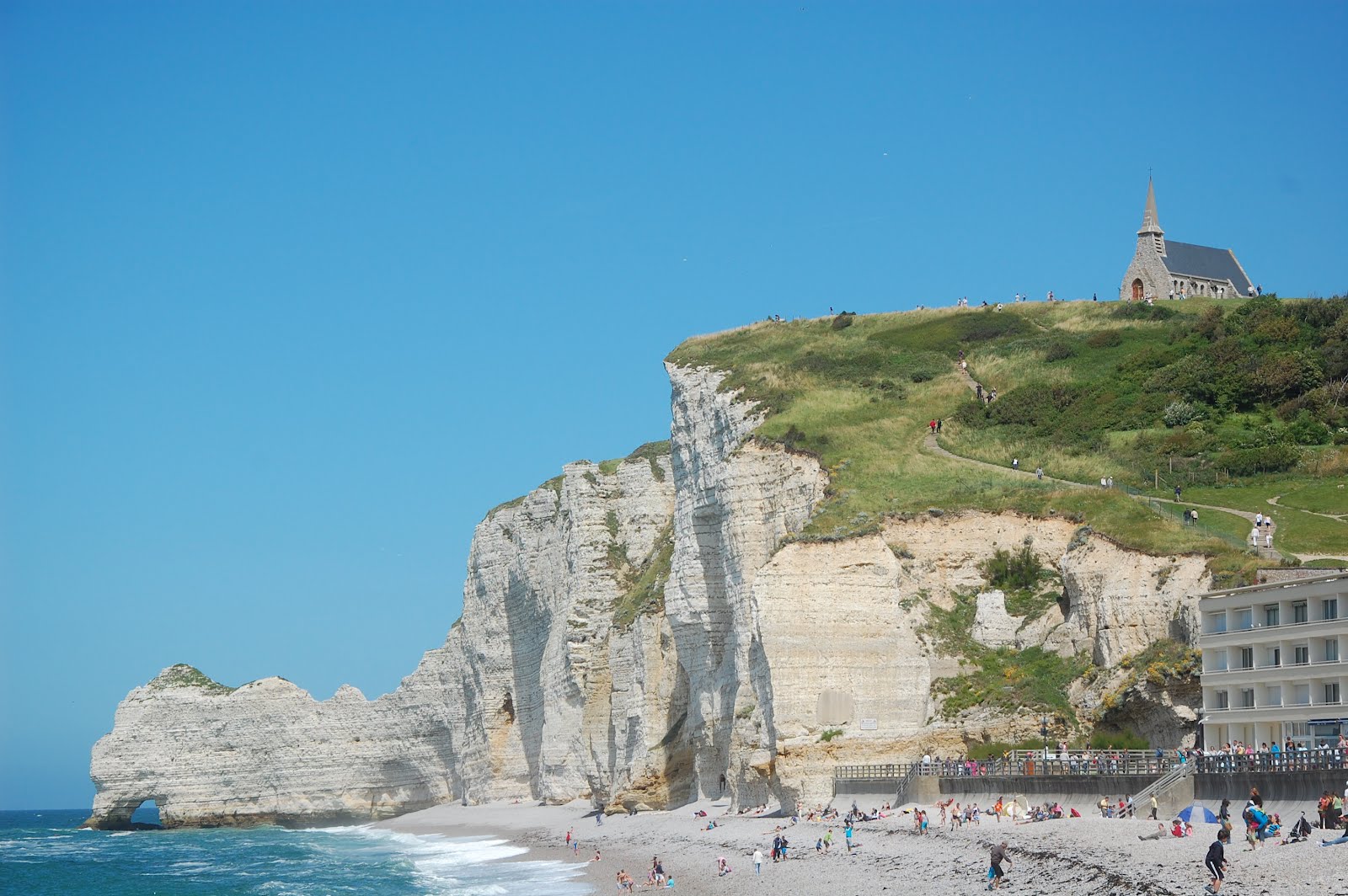
We finally arrived at the spot that is the star attraction of the la Côte d'Albâtre, Étretat.

This is the view to the north showing the cliff including the naturally formed archway, the pathway to the top of the cliff and the chapel overlooking all.
But this is the view that everyone keeps coming back to, the view that has been described as an elephant sticking his trunk down into the sea to drink, the south view.
We made it back to Dieppe in plenty of time to discover that parking is still free.
And still completely not available.

OK, just a couple of small things which despite what the post title says are not strictly nothing but la Manche.

Rent a fence!!!!
The most pleasant monsieur of the madame monsieur ownership couple says they have different sorts of shows out there every weekend. Last weekend they had a circus, this weekend it is a horse show. No matter to us, we are on the road again tomorrow.

But, finally sunset over la Manche at Dieppe.
The weather report said rain and gloomy. Instead we had a perfect day.

Wednesday, July 18, 2012

The parking is free

Travel is tiring so I am probably not going to be as excessively complex in my sentence construction as I usually am.

Not that I am apologizing for being wordy, this is my blog and I get to do what I want.  I like complex construction.

The whole morning went better than expected.  The cab stand at Maubert had at least 8 cabs every time I checked it but when we got there today there was only one.

Just enough.

We couldn't get the English speaking ticket seller at the train station but even the French speaking one knew way enough English to get us safely on the train.

We thought we had to catch the Dieppe train to get to Rouen.  It turns out that you can also catch the Le Havre train. As a result we got to Rouen slightly before the time we thought we would be leaving Saint Lazare.  This is the train station at Rouen.
We rented a car, stowed our luggage in the boot, left the car in the parking ramp rental car storage location and fell down the hill into Rouen.

Sure enough, half timbered buildings abound.

The explanation  given by the book is that the local stone is soft and not conducive to construction but there was an abundant oak forest.
A couple of years ago we visited Chinon and I spent a lot of effort on the beginnings of the military career that began in Chinon, the Maid of Orleans, Jeanne d'Arc.

Today kind of brings full circle to that whole narrative.  This is the market square in Rouen where she was burned at the stake.  The statue of the burning Joan faces out into the square from a nook in the side of the new church .
The church there is new as the old church there was among the sites in Rouen extensively damaged by World War II bombing.

This is the Gros Horloge, the big clock.  The building is the former city hall.
The clock has no minute hand, at the time this clock was relevant keeping track of the hour was plenty exact enough.

The underside of the arch on which the clock is mounted is some nice sculpture dedicated to the dominant ruminant of the area, the sheep.
This stunning Gothic structure is the Palais de Justice, the former home of the Normandie parliament.
The cathedral in town is the Cathedrale Notre Dame of Rouen.  There is currently an extensive renovation underway which rendered the front facade a disappointment as a photographer's model.  The side view is still pretty stunning, though.
The cast iron spire dates only from the 19th century, actually about the same time when Eiffel was building his celebrated tower in Paris.  The spire is by itself 490 feet tall, the tallest in France.

It's a stunning old stone building inside.  It is extremely highly vaulted, much higher than Notre Dame in Paris.
It is also quite a bit lighter inside as very very many of the ancient windows were destroyed in the war.

For example the church on one night in 1944 suffered direct hits to the building and grounds of 7 high explosive bombs dropped by RAF Lancasters.

We were just sort of walking along working our way back towards the train station to pick up our car when just out of nowhere there appeared this deal.
That one is Eglise Saint Ouen.  It is a former abbey church celebrated as one of the jewels of High Gothic architecture.

We were feeling a tiny bit pressed for time or maybe it was hungry so we didn't go inside.

So after one huge false start we managed to get headed in the direction of Dieppe.  Getting into the city also  proved a tiny bit problematic but Dieppe is a smallish place, population according to the Green Guide of only 33,000.  And of course one side is a known so you only have to work yourself towards that one thing you know for sure and then narrow down the possibilities and before you know it you are safely at your destination.

Which for us today was the Beach Hotel.
Not making it up.

We couldn't find a place to park anywhere nearby so we eventually parked in the yellow painted no parking zone in front of the hotel driveway and I went inside.

"You have a booking?" Madame inquired.

"Where does one park?" I asked.

"Parking is free."  she replied.

Well, yes, parking is free but there isn't a single empty spot anywhere around.

It turns out they have a garage the existence of which they will eventually reveal and then you can book a spot inside.

It all seems good to me except that silly moment when she says, "The parking is free".

Of course it is.

So we got checked in and here is the view out the window this time.
It isn't Notre Dame but it IS the English Channel.

Here is a view towards the west, you know down towards Le Havre and Omaha and Cherbourg and all that sort of stuff.
What you see there is the very beginning of the Alabaster Coast.

Tuesday, July 17, 2012

A few final details

I was in front of the church when it opened this morning (0745 in case you need to know) so I headed on in. I wasn't expecting to find anything new but I didn't want to miss one final opportunity to be inside when only a very few other people are in there. I have a new lens for my camera so I got what I think is my best photo yet of the North Rose window.
That window is of Mary surrounded by figures from the Old Testament and is famous for being substantially intact and unchanged since the 13th century.

I paused before leaving the building for one last look at what the guide book calls the high-vaulted central nave down toward the huge transept, the choir and the high altar.
It is a spectacular building, one that never fails to impress at least the likes of me.

I stopped at our new favorite boulangerie and returned to the flat with petite dejeuner.
That's a quiche provencale, a quiche champignon, two chasson au pomme and a couple of apricots.  I have belatedly realized that this tour's postings have been devoid of useful pastry updates.  I can only offer as an apology that I had a croissant aux amande et framboises one day earlier in the trip and I am pleased to report that that particular pastry can readily be characterized as a mighty fine donut.  There have also been several iterations of pain au chocolate, another excellent donut substitute.

Here's another thing I know some people want to see, a look around the flat.  This view is from the window back towards the two steps down to the entry and the kitchen and bathroom level.
Glenn met us at the nearby cafe to facilitate the check in.  He says he believes this is a 15th century building. The ceiling of the main room is dominated by the ancient framing timbers.

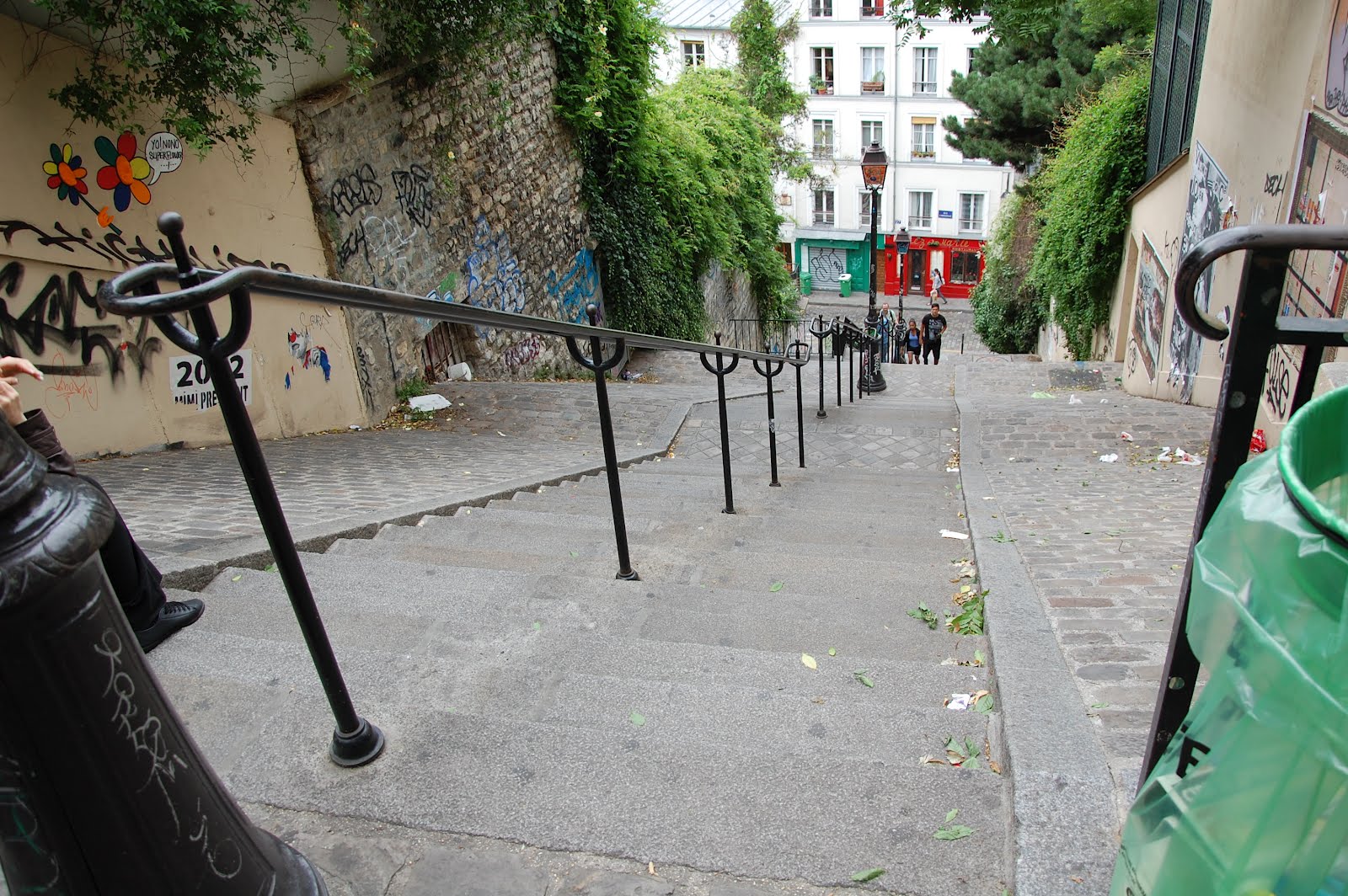
So we headed out for one last thing that we both wanted to do.  I am going to just introduce this by saying that we walked up about 150 steps inside the Metro station before we even saw street level.  I checked the map and located the route to the funiculaire but instead of following that route I just went ahead and followed the sign at the end of the street pointing the way to the basilica.  As a result we never made it to the funiculaire but instead ended up at the bottom of this set of steps.
Which led to the bottom of this set of steps.
We counted both of those sets and it was 86 and 93.  It seemed like a good time to pause and regulate our breathing and heart rates before trying too much else.  It is only a short walk around the corner from those steps to the corner of the basilica,  the Basilique du Sacré-Coeur.
We had a little sit down in Montmarte village.  The tourist foot traffic is an interesting watch as are the approximately 69 dozen guys with sketch pads who will do a caricature of you "for free".
Sacré-Coeur is a landmark but the historic and really interesting church up there is Saint-Pierre de Montmarte.  We visited there last year and I liked it so much that this time I did the proper research and we headed back inside.
The church is all that remains of the great Benedictine Abbey of Montmarte, founded in 1133.  Inside the church are four marble columns said to be from a Roman temple that stood on the site before that time.  That is the detail I was unprepared for last time.  Not this time.  Here are two of those extraordinarily ancient marble columns, behind the altar on the left.
We had walked up the stairs to the mountain, we walked down the terraces and stairs in front of the basilica to leave.  This is one of the most visited and photographed scenes in the city.  I have gotten a couple of photos here before but today I had a good sky background and my camera battery did not expire, problems that have plagued my photography efforts there in the past.
If you don't like that one I have, oh, maybe about a dozen others to choose from.

Back to the flat, here is that oldest tree in Paris thing I have threatened to post.
The tree was planted in 1601 and clearly no longer stands on its own, that faux trunk looking thing on the right is concrete.  There is also concrete filling some of the cracks in the real trunk.  I don't think either of those treatments are accepted silviculture practices any more but on the other hand the tree IS still standing.

While I have been finishing this up the FT has been out walking. I captured her again while she was unaware as she walked through the square just after passing the oldest tree and with the ancient old Eglise Saint Julien de Pauvre as a backdrop.
She's going to be surprised again.

So that's pretty much it for Paris.  Tomorrow morning we are off to Gare Saint Lazare and a train trip to Rouen.  There is a cathedral there that Rick Steves promises is a landmark in art history and also what Rick promises is a cobbled old town with half timbered buildings that is a delight to wander.  By night fall we will be in Dieppe.  I am not positive what the Wi-Fi situation is going to be in Dieppe but we will endeavor to persevere with the travelogue.